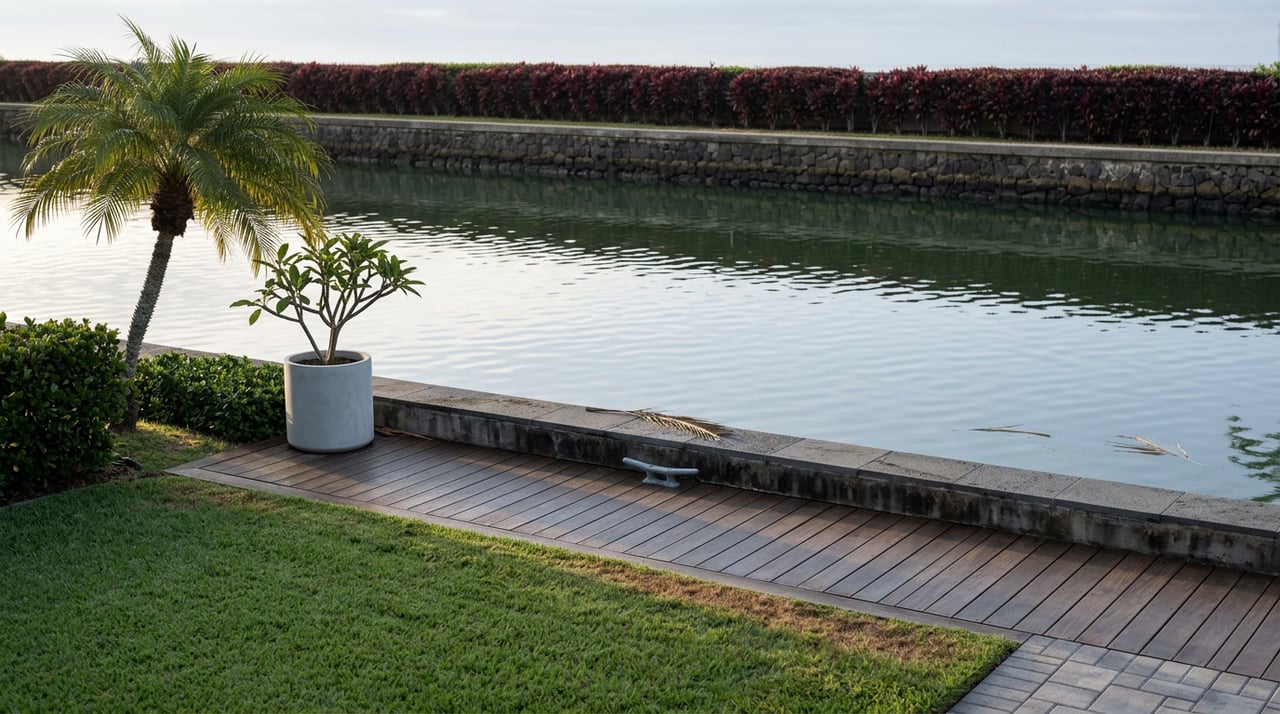
A buyer stands on the dock behind a marina-front townhome in Kuapa Isle, watching a kayaker glide past toward Maunalua Bay. The agent gestures at the slip and says the word every waterfront listing uses: included. The buyer nods, pictures a boat there by summer, and moves on to the kitchen. Three weeks later, during escrow, the title report comes back and the slip isn't part of the legal description at all. It's assigned by the association, subject to a waitlist, and technically belongs to no one until the board says otherwise.
This happens often enough in Hawaii Kai that it deserves its own conversation, separate from square footage and finishes. The marina is Oahu's only major private waterway wrapped around a residential community, and that structure creates a set of ownership questions that don't come up anywhere else on the island. "Included" on a listing sheet and "included" on a deed are frequently two different things, and the gap between them is where buyers get surprised.
The Word Doing More Work Than It Should
A slip attached to a Hawaii Kai property generally falls into one of three categories, and each one behaves differently at closing. A deeded slip is a real property interest that transfers with the title, the same way a parking stall might. An association-assigned or usage-based slip is governed by the Hawaii Kai Marina Community Association's rules and CC&Rs, which means it can require board approval, sit on a waitlist, or simply not convey to a new owner without a separate application. A commercial or rented slip, the kind available through Koko Marina Center, is a lease arrangement entirely apart from the home sale.
None of this shows up on a walkthrough. It shows up in the deed language, the plat, and the association's own records, which is why a slip described as "included" is really just a starting point for the question a contract review is supposed to answer.
The Association That Manages the Water, Not the Wall
The Hawaii Kai Marina Community Association, or HKMCA, runs the day-to-day life of the waterway. It sets vessel speed limits, issues registration decals, schedules the annual Fuel Day, and enforces no-wake hours from sunset to eight in the morning. What it does not do, by its own published rules, is take responsibility for the seawall in front of an individual home.
HKMCA's own rules describe seawall repair as "the sole responsibility of single family dwelling owners."
That single clause is worth sitting with, because it inverts what most buyers assume an association exists to do. Condominium associations exist, in part, to pool cost and spread risk across owners. HKMCA does some of that for the shared waterway itself, but it draws a hard line at the property boundary. Here is how the responsibility actually splits, according to HKMCA's posted marina rules:
| Structure Type | Who Repairs the Seawall |
|---|---|
| Single-family home | The individual homeowner, in full |
| Condominium land (Kuapa Isle, Koko Isle Circle, and similar) | The condo association |
| Shopping centers (Koko Marina Center, Hawaii Kai Shopping Center, Hawaii Kai Towne Center) | The commercial property owner |
The Hawaii Kai Shopping Center's own seawall project is a useful reference point. It ran from January through July of this year, backed by a commercial owner with contractors, engineering support, and presumably a capital budget, and the repair still took roughly seven months to finish. A single-family owner facing a comparable wall has none of that infrastructure unless they've planned for it themselves.
Why the Rules Read This Way
The marina wasn't built as a typical residential amenity, and its governing structure reflects that. The waterway was once Kuapa Pond, leased by the Bernice P. Bishop Estate to Kaiser Development Company starting in 1961. Over roughly two decades, Kaiser drained the pond, built the rock walls that still line the canals, and created the land for homes and shopping centers. In 1979, the U.S. Supreme Court designated the marina as private property, closed to the general public. Ownership passed from the Bishop Estate to the newly formed Hawaii Kai Marina Community Association on July 5, 1991.
That history matters because it explains the odd split in responsibility. The marina functions less like a shared amenity and more like a private easement that residents collectively govern but individually maintain at the property line. HKMCA's dues fund patrol, water quality work, and shared events like the Holiday Light Parade of Boats. They don't fund your seawall.
What Ownership Costs Before the Boat Ever Leaves the Dock
For 2026, HKMCA's annual dues are $600, due January 1. That's the baseline for belonging to the association at all. Beyond that, vessel registration is tiered in a way that rewards waterfront ownership specifically: HKMCA's fee schedule, known as Exhibit A, lists a $20 annual rate for a marina waterfront resident's vessel against $575 annually for a boat owned by a non-marina Hawaii Kai resident, with a $25 late fee applied to any re-registration completed after January 31.
Guest access is limited too. A waterfront resident is allowed one guest boat per month, and the pass has to be arranged through the marina office in advance. None of this is prohibitive, but it's the kind of detail that changes how a buyer plans a boating life around the property, not just how they price it.
Condo maintenance fees add another layer on top of HKMCA dues, and the itemization can get specific. A 2026 listing at the Esplanade broke its $2,129.01 monthly fee down to individual line items, including a $50 Hawaii Kai Marina fee and a $20 Luna Kai Marina Park fee stacked separately from parking and cable charges. Compare that to a single-family marina-front listing on Kawaihae Street, active as of May 2026 and advertised plainly as having no HOA fees at all. In that arrangement there's no association absorbing any share of the seawall cost. There isn't one to absorb it.
Where the Difference Actually Shows Up on a Deed
Most of the marina's condo and townhome communities, including Kuapa Isle, Koko Isle, Mawaena Kai, the Esplanade, Gateway Peninsula, and Kalele Kai, manage slips through their associations rather than through individual deeds. That's not a flaw. It's simply a different ownership structure than a private dock behind a single-family lot, and it means slip access in these buildings often comes with rules about transfer, approval, or waitlists that a buyer needs in writing before assuming continuity.
True single-family marina frontage with a private, deeded dock is scarcer. A listing in the gated Peninsula at Hawaii Kai, active in April 2026, described the home as one of only 27 single-family marina-front properties in that entire community. That scarcity is worth knowing going in, because it means most marina access currently on the market runs through an association, not a deed, and the two carry very different obligations.
The Paper Trail Worth Requesting Before You Write an Offer
A short list, requested early, resolves nearly all of this before it becomes a closing surprise:
- The recorded deed or plat language describing the slip, confirming whether it's a real property interest or a reference to association use rights
- Written confirmation from HKMCA of the property's registration category and whether the slip transfers automatically on sale
- Any seawall repair invoices, engineering reports, or maintenance history specific to the lot
- Recent association minutes or reserve studies referencing seawall condition or planned assessments
- Confirmation of the guest pass and vessel registration terms tied to the specific unit or lot
This is the kind of due diligence that belongs alongside a standard title review, and it's worth understanding how Hawaii title generally handles ownership structure and closing costs before layering marina-specific questions on top.
A Few Questions Worth Asking Directly
Does a boat slip always come with the house in Hawaii Kai? Not automatically. It depends on whether the slip is deeded, association-assigned, or a separate rental through Koko Marina Center. Each has different transfer rules, and only a deeded slip is guaranteed to convey with the sale.
Who handles boat registration once I own a marina property? HKMCA manages registration directly, and the annual fee depends on whether you're classified as a marina waterfront resident or a non-marina Hawaii Kai resident, a distinction that affects the rate significantly.
Can I let a friend keep a boat at my dock long-term? Guest access is limited to one boat per month through a pass arranged in advance with the marina office, which means a slip isn't something an owner can informally hand off outside the household.
The Fine Print Is the Point
None of this makes Hawaii Kai's marina any less desirable. It makes it a place where the paperwork matters as much as the view, and where a buyer's advisor should be reading deed language with the same attention they bring to the dock itself. That's the kind of review Beth Chang built her practice around long before real estate, and it's the reason a Hawaii Kai offer should never rest on the word "included" alone.
If you're evaluating a marina-front property in Hawaii Kai and want a clear read on what actually conveys, let's connect.
This article is general information, not legal, tax or financial advice. Consult a qualified professional about your situation.